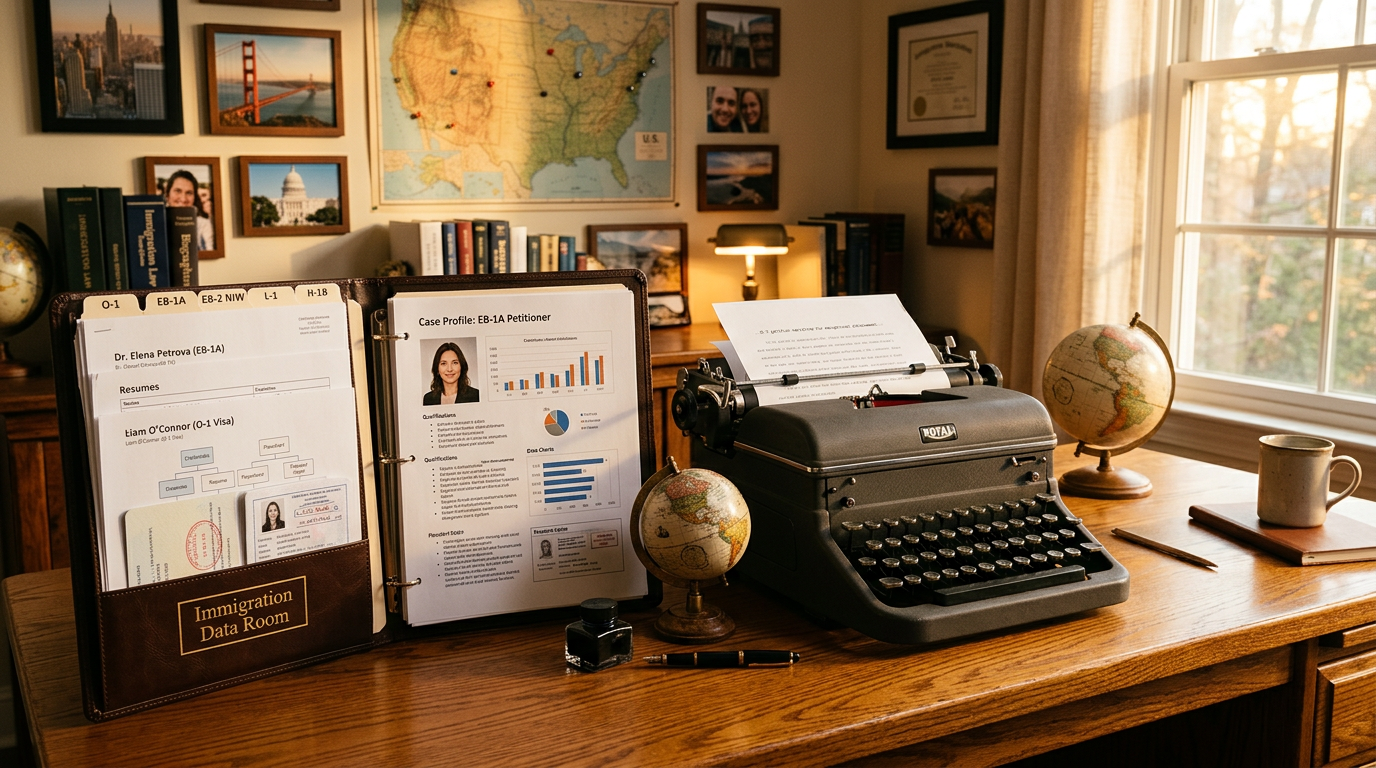
A Practical System for Building a Strong O-1, EB-1A, EB-2 NIW, or L-1 Case
For founders and high-achieving professionals, a U.S. immigration petition is won on organization, evidence quality, and narrative clarity.
The problem is that most people approach immigration evidence the way they approach email: scattered, reactive, and impossible to audit under pressure.
A better approach is borrowed from fundraising and M&A: build a data room. In immigration terms, a data room is a structured, continuously updated repository of exhibits that makes it easier to (1) choose the right path, (2) draft better legal arguments, (3) reduce mistakes, and (4) move faster when timing matters.
Below is a practical, repeatable system you can use, whether you are pursuing an O-1, EB-1A, EB-2 NIW, or an expansion-driven L-1.
Important: This article is educational and not legal advice. Always confirm strategy and eligibility with qualified immigration counsel.
Why a “data room” approach works for immigration
Immigration is evidence-heavy by design. USCIS does not just want accomplishments. Officers want proof that maps cleanly to a legal standard.
A data room helps you:
- Prevent omissions that trigger delays or weak filings
- Reduce last-minute scrambles for letters, exhibits, and translations
- Create consistency across your resume, press, contracts, and supporting letters
- Speed up drafting because your strongest exhibits are already curated
- Make attorney review more efficient because your materials are structured, not scattered
This is especially useful for extraordinary ability style cases, where the adjudicator is assessing the totality of evidence.
Step 1: Anchor your data room to the USCIS standard you are targeting
Before you create folders, confirm what you are actually trying to prove.
A few high-level examples:
- O-1: The petition must include evidence that aligns with at least three types of documentation listed in the regulations (or comparable evidence), and an approved O-1 petition is generally valid for the time needed for the event or activity, up to three years.
- EB-1A: You must either show a one-time major internationally recognized award or meet at least 3 of 10 criteria, and you must demonstrate sustained national or international acclaim.
- EB-2 NIW: You must qualify for EB-2 and then satisfy the three-prong national interest framework: substantial merit and national importance, well positioned to advance the endeavor, and on balance it benefits the U.S. to waive the job offer and labor certification requirements.
- L-1A (including “new office” scenarios): For a new office, USCIS expects evidence such as secured physical premises and the initial period of stay is limited to one year.
You do not need to memorize every nuance. You do need your evidence system to reflect the standard.
Step 2: Build a folder structure that matches how petitions are assembled
Create a single top-level folder called something like US Immigration Data Room, then use this structure:
1) Identity + immigration history
Store clean PDFs of:
- Passport biographic page(s)
- Current and past visas (if applicable)
- Prior approval notices, I-94s, DS-160 confirmations, entry stamps
- Any prior RFEs, decisions, or notices (if applicable)
2) Master timeline (your single source of truth)
Create a one-page timeline that includes:
- Roles, titles, and dates
- Major launches, funding events, product milestones
- Speaking engagements, awards, press, publications
- Any critical inflection points you may want a letter writer to reference
This timeline becomes the backbone for consistent drafting.
3) Role and leadership evidence
Examples:
- Offer letters, employment verification, board minutes (as appropriate)
- Organizational charts
- Proof of “leading or critical role” in distinguished organizations (commonly relevant to O-1 and EB-1A-style arguments)
4) Recognition and third-party validation
Examples:
- Press coverage (PDFs, not just links)
- Awards and nomination materials
- Speaking invitations, conference agendas, programs
- Evidence of judging, reviewing, or selection committees
5) Impact and “objective” proof
Examples:
- Product metrics (users, revenue, retention, growth charts)
- Patents, citations, open-source adoption
- Customer logos, contracts (redacted as needed), partnership letters
- Independent analyst reports or market references (where relevant)
This folder often does more work than ten generic exhibits.
6) Plans for U.S. work (future-facing exhibits)
Many strong profiles still get weakened by vague future plans. Save:
- Draft deal pipeline, project roadmap, product roadmap
- For NIW: a clear endeavor description and supporting documents that show broader implications
- For O-1: documents that support the planned activities
- For L-1 new office: premises evidence plus a credible first-year operating plan
7) Recommendation letter bank (make this a system, not a scramble)
Create subfolders for:
- “Confirmed recommenders”
- “Targets to approach”
- “Draft bullets per recommender”
- “Final signed letters”
- “Recommender proof” (who they are, why their voice matters)
Letters are often a bottleneck. A letter bank turns them into a manageable workflow.
Step 3: Add evidence hygiene rules so your exhibits survive scrutiny
A data room is only helpful if it is reliable. Adopt three rules:
- Save source documents, not screenshots. If it is press, save a PDF of the page. If it is analytics, export the report.
- Name files consistently. Example:
2025-09 Press - Publication - Headline.pdf - Track what each exhibit proves. Add a simple spreadsheet with columns: Exhibit name, date, criterion supported, why it matters.
This is how you avoid the “we have a lot of stuff” trap and move toward “we have the right proof.”
Step 4: Turn the data room into a petition blueprint
Once your data room exists, you can build a clean blueprint:
- Identify the 3 to 5 strongest themes in your profile (impact, leadership, recognition, originality, etc.).
- Select exhibits that prove those themes with minimal redundancy.
- Ensure every claim has a document behind it.
Quantity does not win. Clear, credible proof does.
Where Jumpstart fits: structure, speed, and risk reduction
Jumpstart positions itself as an AI-powered immigration service for founders, executives, and distinguished professionals, combining technology with legal oversight.
Practically, the value of a data room increases when your partner can operationalize it:
- AI-assisted analysis and drafting to streamline document preparation and reduce client workload
- A triple review process that includes technology, paralegals, and attorneys
- A money-back guarantee: Jumpstart states that if the application is not approved, it refunds its fees
- Transparent package pricing and timelines listed on its pricing page, including installment options (and government fees shown as estimates)
- “Jumpstart Insurance” that covers the government filing fee in case of reapplication up to US$600
The takeaway is simple: a strong petition is built like a strong company narrative. The data room is your infrastructure.